How Much Is My Card Worth?
That’s probably the question that brought you here. Hopefully, this free site will help you determine the retail value of your card(s).
VINTAGE MASS PRODUCTION CARDS:
It is important to note that in this guide, “vintage” cards refers only to cards issued before 1981. We have created price guides for all of the major issues. and most of the smaller issues. Cards made after 1981 are listed only if they retail at $5.00 or more.
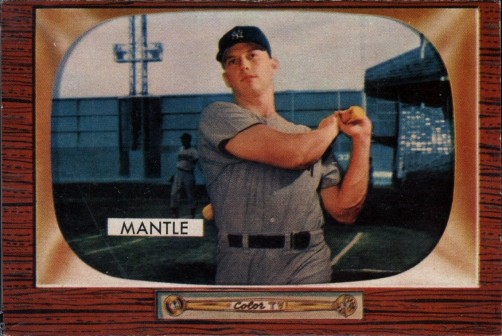
Remember that the values in our price guide are for cards in “Near Mint” condition. As a rule of thumb, you would cut that price in half for every grade lower. For example, a 1954 Bowman #2 Jackie Jensen is valued at $60.00 in Near Mint condition. If it is in “Excellent” condition, it’s going to sell for half of that, about $30. In very good condition, you would divide in half again, and it’s a $15 card. In good condition, $7.50 is about where the retail price should be. In fair condition or lower, the price would be $3.75 or less. On the other hand, if a card is in better than Near Mint condition, meaning it is true mint, you would double the book value to $120.00
There is a link in the sidebar with detailed and illustrated help in grading your cards.
NEWER MASS PRODUCTION CARDS:
If you need the values of mass-production cards created after 1981, this site isn’t going to be quite as helpful. The reason is that after 1981, some very bad things happened to the baseball card industry. First, the baby-boomer generation came along, and each of them had 2.3 kids. They all wanted to get their kids started collecting baseball cards before they were even potty-trained. Even kids who hated sports had huge baseball card collections. There were plenty of girls who had card collections. Baseball cards were touted as an “investment” and were carefully stored in albums.
Too many cards were printed during the era, making 99% of all cards issued after 1981 not even worth the recycled value of the pasteboard they are printed on. Also, rather than printing the exact same number of cards for each player, some manufacturers started printing extra cards of the big stars. This diluted their value. Since nearly all of these cards are worth as close to zero as you can get, the only intelligent way to assign a value to them would be to estimate them at so much per pound.
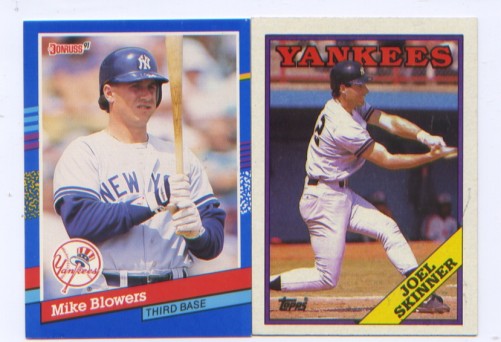
On eBay, you can buy a 25lb box of cards like these, including stars and Hall Of Famers, for about $1 per pound. The shipping cost usually exceeds the resale value of the cards…
It wasn’t just the numbers printed that make these cards so undesirable. The card companies changed the way cards were designed, and they became incredibly boring. The old cards had great biographical write-ups on the backs, often featuring cartoons, quizzes, and what hobbies the player enjoyed. For some reason, this changed into an entire back filled with mostly statistics. Not that stats are bad, but why do I care how often the guy grounds out against lefties in night games? That’s too much information.
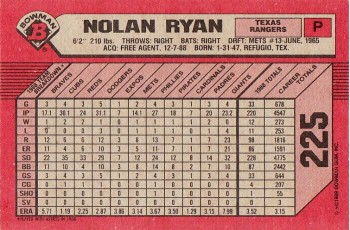 This is an example of the sheer laziness of just throwing a bunch of stats on a card. It strips away every vestige of artful design, and becomes simply a dossier. Is it any wonder collectors hate the 1989 Bowman set? They couldn’t think of anything interesting to say about Nolan Ryan?
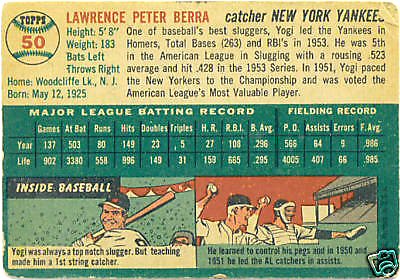
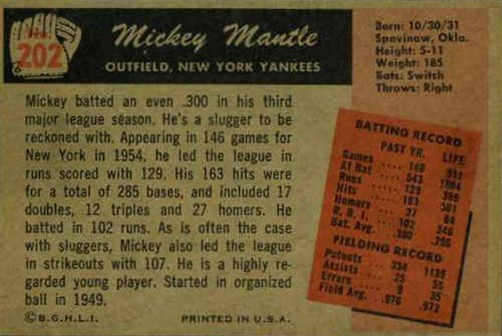
This is what a card back used to look like.
Of course, in the midst of all of this printing, some valuable cards did get made. Any rookie card of a future or present Hall Of Famer is worth something. Ripken’s rookie cards came out in 1982. You’ll find rookie cards for Barry Bonds, Roger Clemens, Mark McGwire, Ken Griffey Jr., and other superstars. However, the steriod scandals have diluted the value of these cards significantly. Cards issued after 1981 sell on eBay and other shops for far less than their usual book values, even in Near Mint or better condition. This indicates that the book values assigned to these cards is largely fictitious.
We have created price lists of mass-produced cards made after 1981, but only for those which retail for $5 or more. Sadly, the most valuable of these are error card variations.
The best strategy for pricing post-1981 cards is to see what others are selling the card for. Don’t worry, it’s very easy to find someone who is selling ANY card made after 1981 on eBay and many other sites. Essentially, post-1981 cards are worth whatever you can get for them.
Here is a great article written by a guy who found this out the hard way:
I thought my baseball card collection had value. It did, but only to me.
But don’t toss out all of your cards just yet.
There are notable exceptions which were produced during the era before and after 1981. These include: Cramer (which later became Pacific); Miller Press; SSPC; Superior: and others.
Because these sets were printed in lesser quantities (in some cases 50 or less of each card), they have more intrinsic collectible value, so we have created price guides for some of them, and continue to add more as time permits.
Also, Topps has started to produce interesting cards again, and the print runs are far lower than the 1,000,000+ card issues of the late 80s. The Topps Heritage cards are an excellent set to collect. Their product line has improved during the past few years. However, they are still “borrowing” designs heavily from their glory years of ’52-’75.
ART CARDS AND LIMITED EDITIONS:
With the recent advent of “art cards” “sketch Cards” “printing samples” and other varieties, we have decided to create guides for the various manufacturers. There are some innovative “hobby” printers and artists creating interesting and unusual work. This has elevated the creation of sports cards to a new art form, and has generated new excitement among card collectors. Some of these new cards are printed in the traditional way on printing presses (offset litho), while some are made on inkjet printers at home. Some card buyers will accept only offset-printed cards, while others are comfortable with the home made varieties.
Home Made: If you are looking for a book value for any card created on an inkjet printer, you may be disappointed to learn that they are worthless as collectibles. No matter how attractive they look, they can have no collectible value. The first reason is that there is an unlimited print run, and anyone can reproduce them cheaply. The second (and more important) reason is that digital inks are water-soluble, and the air is filled with tiny molecules of water, which eventually dissolves the ink. Light also breaks down these inks, as does ozone – two things which are omnipresent, even in the most controlled environment. These factors will incrementally destroy the ink, starting with fading and blurring, loss of detail, and a “washed out” look. Eventually, the image will vanish. All of this will occur within somewhere between 10 and 100 years in a museum setting, much sooner at home. So these type of cards will not survive long enough to acquire any age-related value. In fact, it is the exact opposite: Unlike “real” cards, which appreciate in value with age, any value assigned to these type of cards will go down with age as their condition slowly degrades. They are most “valuable” when they are brand new, and it goes down from there. Which is contrary to the whole idea of “collecting” cards, and is also why they are not considered collectible. However, some of them do possess aesthetic value as decor, ephemera, folk art, conversation-pieces, or whatever you wish to call it, but it must be remembered that they are temporary pieces which will not stand the test of time using current technology. In the meanwhile, although they are not collectible, these cards can still be sold. People buy them every day, knowing exactly what they are.
Offset-Litho: All of the traditional old cards were printed using this process, including Topps, Fleer, Upper Deck, and the old tobacco and gum cards. This term simply means printed on a printing press, using traditional inks and card stock. Cards printed on a press last much longer – essentially forever. There is of course a greater cost involved in producing these cards, especially when the production is limited to a small number. These are collected by a wider range of collectors, and some of them are very nicely made. There is a greater demand for offset-litho printed cards, and in most cases they are more carefully designed than homemade cards – probably because they cost so much more to make. These factors are enough to give them an intrinsic retail value.
We have created product descriptions and retail price guides for some of the recent limited edition cards and art cards, and will add more as time permits.
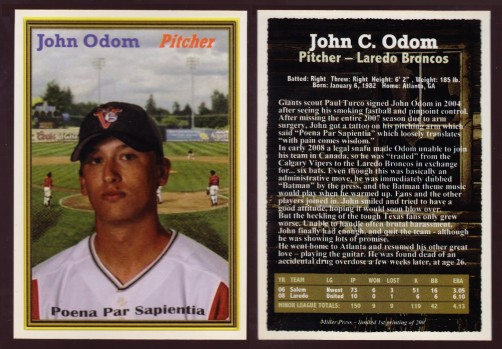
Topps would never do a card of John Odom, aka “the Bat Man” – which is why tribute cards have become popular. This example, of which 200 were produced by Miller Press, is nearly extinct. With 200,000 “serious” collectors in the US, only 1 in 1,000 will ever own one of these. You will probably never get to see one of this card in person. That’s the advantage of the limited edition “microprintings” – they are rarities starting on day one.
HOW MUCH SHOULD I SELL IT SELL FOR?
How do the prices in this guide differ from other “book value” price guides? They are based on what people actually pay for the cards, rather than arcane mathematical formulas.
For example, a 1964 Topps Yogi Berra, Bob Gibson, Bill Mazeroski, and Luis Aparicio all have the same “official” Beckett book value. But ask any card dealer, and he will tell you that Berra and Gibson are worth more than Luis or Maz. Why? Because Berra was a Yankee and players in larger markets have more fans. Because Gibson was a Cardinal (the Cardinals won the World Series that year), and World Champions have more fans. More fans mean more collectors, more buyers, and greater demand. In this price guide, you will see a difference in value between these cards, reflecting the real-world value.
So this price guide is designed to help you intelligently set an actual retail price, rather than to provide a statistical abstract that has little meaning in the real world of card collecting and selling.
If your card is not listed in the pricelists, click the link at the right called “Setting A Price”. This is a tool you can use to get a ballpark value on any sport or non-sport card, from any era.
If you are pricing a card that has no assigned collectible value, such as one produced on an inkjet printer, it can still be sold. In fact, it is certainly worth more money than the majority of post-1981 cards. Check eBay to see what similar cards are going for. Just remember that the value of these cards will decrease in time due to condition, while the “worthless” cards of the 80′s and 90′s will someday acquire some value.
If you are deeply involved in the business of selling and buying cards, you probably ought to join a paid site, like Beckett, because they are a valuable resource and reference, well worth a few bucks a month.
For the occasional seller or buyer, and for the average collector, we hope this little site can be of some help to you.
Happy Collecting!
CARDHOG